How It Works
How APR Control and APR‑E Valve work
Both Rawal Devices' products do the same fundamental job: add continuous capacity modulation to a standard DX system so it runs at part load instead of short cycling. One is mechanical, one is electronic. Here is how each works, and which one fits which application.
APR Control: The Mechanical Valve
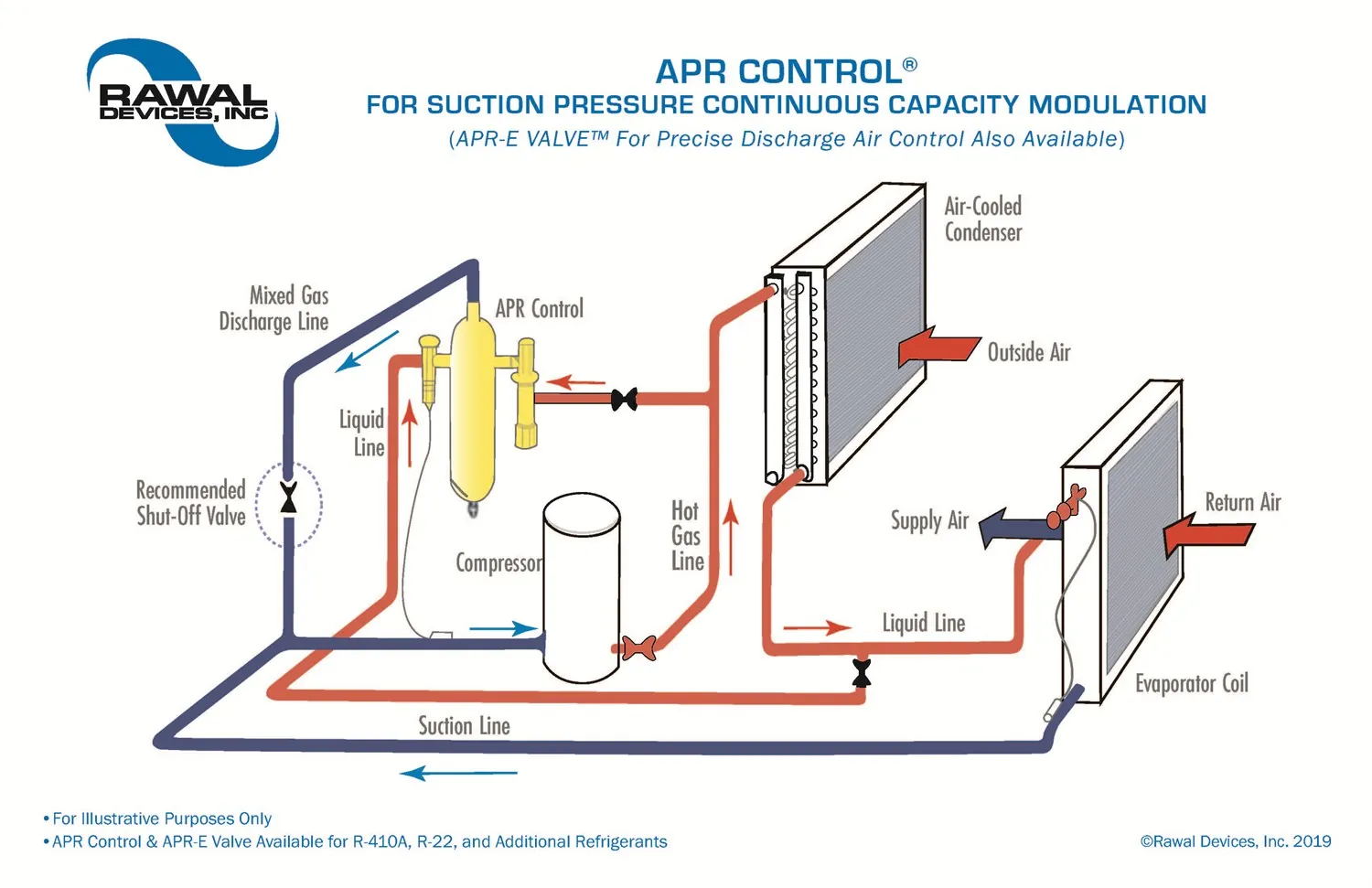
APR Control is an external compressor unloader, a suction pressure-activated mechanical valve installed with three refrigerant connections. As the load on the evaporator diminishes, the APR Control modulates refrigerant flow to match real-time load conditions, so the compressor keeps running at reduced capacity instead of satisfying the thermostat and shutting off. Turndown reaches upwards of 80%+ depending on unit configuration.
- Purely mechanical and pressure-activated: no power, no wiring, no controls to program
- Sized to the lead compressor by Rawal Devices Engineering
- Passive evaporator freeze protection
- No impact on the unit's rated capacity during design day conditions
- Compatible with R-410A, R-454B, R-32, and legacy R-22
Isn't this hot gas bypass? No. Hot gas bypass masks capacity with a false load; APR Control genuinely reduces the capacity the compressor produces to match the real load, so it improves the refrigeration effect instead of wasting it. See APR Control vs. hot gas bypass.
APR‑E Valve: The Electronic Version
APR‑E Valve adds electronic control on top of the same continuous-modulation principle. A command signal from your building automation system or a stand-alone controller (0 to 10VDC or 4 to 20mA) tells the APR‑E Valve how much to modulate, and it continuously adjusts capacity to hold a precise leaving-air condition. It holds discharge air temperature to ±1°F on DAT control, and every minute can be trend-logged as a record.
- Electronic: driven by a BAS or stand-alone controller signal (0 to 10VDC or 4 to 20mA)
- Holds discharge air temperature to ±1°F on DAT control
- Installed with three refrigerant connections plus control wiring
- Every minute documented for applications where the trend log is the record
- Compatible with R-410A, R-454B, and R-32, plus legacy refrigerants such as R-22
Best Applications for Each Valve
Both valves make an oversized system run instead of cycling. The difference is whether you need a precise, documented leaving-air temperature (APR‑E Valve) or reliable, low-maintenance modulation with nothing to program (APR Control).
Choose APR Control when
- The goal is reliability and humidity on comfort equipment
- You want nothing to power, wire, or maintain
- Rooftop units and split systems across a campus or portfolio
- Schools, restaurants, offices, patient-area RTUs, industrial spaces
- Any oversized DX system that short cycles
Choose APR‑E Valve when
- The application needs a precise, repeatable leaving-air temperature
- The trend log has to document conditions
- DOAS and makeup air units
- Labs and cleanrooms, indoor agriculture (VPD control)
- Data centers and critical facilities, documented healthcare spaces
Not sure which fits? See which system types each valve is compatible with, or a Rawal Devices Engineer routes you to the right one.
APR Control Installation Illustration
How the APR Control connects
Three refrigerant connections. The APR Control modulates refrigerant flow to match the real-time load, so the compressor runs at part load instead of cycling on and off.