
ABSTRACT
The APR Control is routinely misclassified as “hot gas bypass” because both devices connect the compressor discharge line to the suction side of the circuit. The resemblance ends at the pipe fittings. Hot gas bypass is, by definition, a false-load device: it delivers hot discharge gas to the low side so that a fully loaded compressor can keep running without freezing the coil, at a deliberate energy penalty. The APR Control is a modulating external compressor unloader: it diverts a controlled portion of compressor discharge through a desuperheating chamber and returns cool gas to suction, unloading the compressor in proportion to the load deficit. This paper states the industry definition of hot gas bypass as four testable properties, and shows from instrumented bench and field-laboratory data that the APR Control exhibits the opposite of all four: the diverted gas returns cool rather than hot; the compressor unloads rather than staying loaded, with power and amperage falling in every matched pair; the action is proportional capacity modulation to a suction-pressure setpoint rather than a fixed energy penalty; and compressor thermal stress falls rather than rises, with compression ratio and dome temperature lower throughout. A fifth measured result sits alongside the four: because the diversion loop circumvents both heat exchangers, refrigerant circulation through them is reduced rather than preserved, and both coils operate at lower approach. The contrast reaches the refrigerant itself: hot gas bypass dries the evaporator by injecting vapor into its feed, while the APR Control never touches the coil's feed at all. The expansion device meters as it always has, and at light load the coil simply runs wetter, capacity falling with the evaporator more effective per unit of surface and flow rather than less. The correct mechanism family in the literature is suction gas modulation, not hot gas bypass. The paper closes with the practical consequences of the mislabel, including its collision with the hot-gas-bypass limitations of ASHRAE 90.1 §6.5.9 and IECC §C403, and the terminology that accurately describes the device.
1. INTRODUCTION
Any device that pipes compressor discharge gas toward the suction side of a direct-expansion circuit invites the label “hot gas bypass.” The label is understandable, and wrong. “Hot gas bypass” is not a generic description of pipe routing; it is an established term of art with a specific meaning, a specific purpose, a specific set of known liabilities, and a specific set of restrictions in the energy codes. When the APR Control is filed under that term, every one of those meanings, liabilities, and restrictions is silently attributed to a device that has none of them. The historical record makes the same point the data will: the device has been its own patented invention since 1993 (Davis Rawal, U.S. Patent No. 5,240,651), three decades of distinct identity and field application preceding the measured record in this paper.
Rawal Devices published a two-page comparison of the APR Control and hot gas bypass in 2020 [2]. This paper is the data-backed successor to that document. It draws on two instrumented datasets analyzed in the companion white paper series [5, 6]: a controlled bench test, conducted in a psychrometric chamber, of a two-compressor 10-ton package unit (R-410A) in which the APR Control was installed on the first-stage compressor only, giving matched-condition comparisons with the valve open and closed and an untreated second compressor as an internal control; and a separately instrumented R-454B dedicated outdoor air system in a laboratory setting [6], whose logs directly instrument the diversion circuit itself. The two datasets are reported separately throughout and are not numerically combined. Where a claim rests on field experience, published literature, or inference rather than measurement, it is labeled as such.
A note on scope: the laboratory DOAS logs were recorded without the author present, under operating conditions that were not fully controlled or documented; that dataset is used here only for mechanism verification through simultaneous-channel relationships, not for performance claims. The bench dataset supports the quantitative comparisons.
2. WHAT HOT GAS BYPASS IS
In conventional practice, hot gas bypass is a false-load device. A valve routes hot compressor discharge gas into the evaporator, typically injected at the evaporator inlet downstream of the expansion device, for the express purpose of adding heat to the coil. The added heat is an artificial load: it props up suction pressure so the equipment can continue running at low load without tripping safeties or frosting the coil. From that definition follow four properties that any engineer trained on hot gas bypass will assume of a device carrying the name:
Property 1. The bypassed gas arrives hot. The heat is the point. The gas enters the evaporator at or near discharge temperature; that is what creates the false load.
Property 2. The compressor stays loaded. Mass flow through the compressor is essentially unchanged; the machine keeps compressing the same gas, part of which is simply recirculated. Power draw does not fall.
Property 3. It is an energy penalty by design. The compressor performs work that produces no cooling. Hot gas bypass trades efficiency for freeze protection and minimum-load stability.
Property 4. It raises compressor thermal stress. Recirculated hot gas elevates suction temperature and superheat, which elevates discharge temperature. The classic hot-gas-bypass failure mode is compressor overheating, which is why such systems frequently require liquid injection or other desuperheating simply to survive. Standard application guidance accordingly recommends such desuperheating alongside hot gas bypass; in field practice it is rarely installed (field experience).
These four properties are testable. The remainder of this paper tests them against the APR Control's instrumented record. All four fail.
3. WHAT THE APR CONTROL IS
The APR Control is a mechanical, self-regulating, modulating external compressor unloader. At part load, reduced heat content in the return air pulls suction pressure down. The APR Control's compression-ratio-reduction valve, set near 40°F saturated suction (approximately 118 psig for R-410A) and adjustable, opens below setpoint and modulates. It diverts a controlled portion of compressor discharge gas through a desuperheating chamber, where the gas swirls and dissipates its heat, and returns it to the compressor suction as cool gas. If compressor superheat exceeds approximately 20°F, a liquid injection valve admits liquid refrigerant to flash against the discharge gas and cool it further; below that threshold the valve is fully closed, and no liquid ever exits the chamber. Both the desuperheating chamber and the liquid-injection backstop are integral to the assembly: the protection that hot-gas-bypass guidance recommends and field practice usually omits is, here, not an option but the construction. The net effect is to unload the compressor: effective evaporator tonnage falls, amperage falls, suction pressure is restored toward setpoint, and head pressure falls. The valve uses only as much of its rated modulation range as the load deficit requires.
The distinction in one sentence: hot gas bypass adds heat to keep a fully loaded compressor from freezing a coil; the APR Control removes heat from a diverted gas stream in order to unload the compressor and modulate capacity. Same pipe fittings, opposite physics.
3.1 The distinction on the pressure–enthalpy diagram
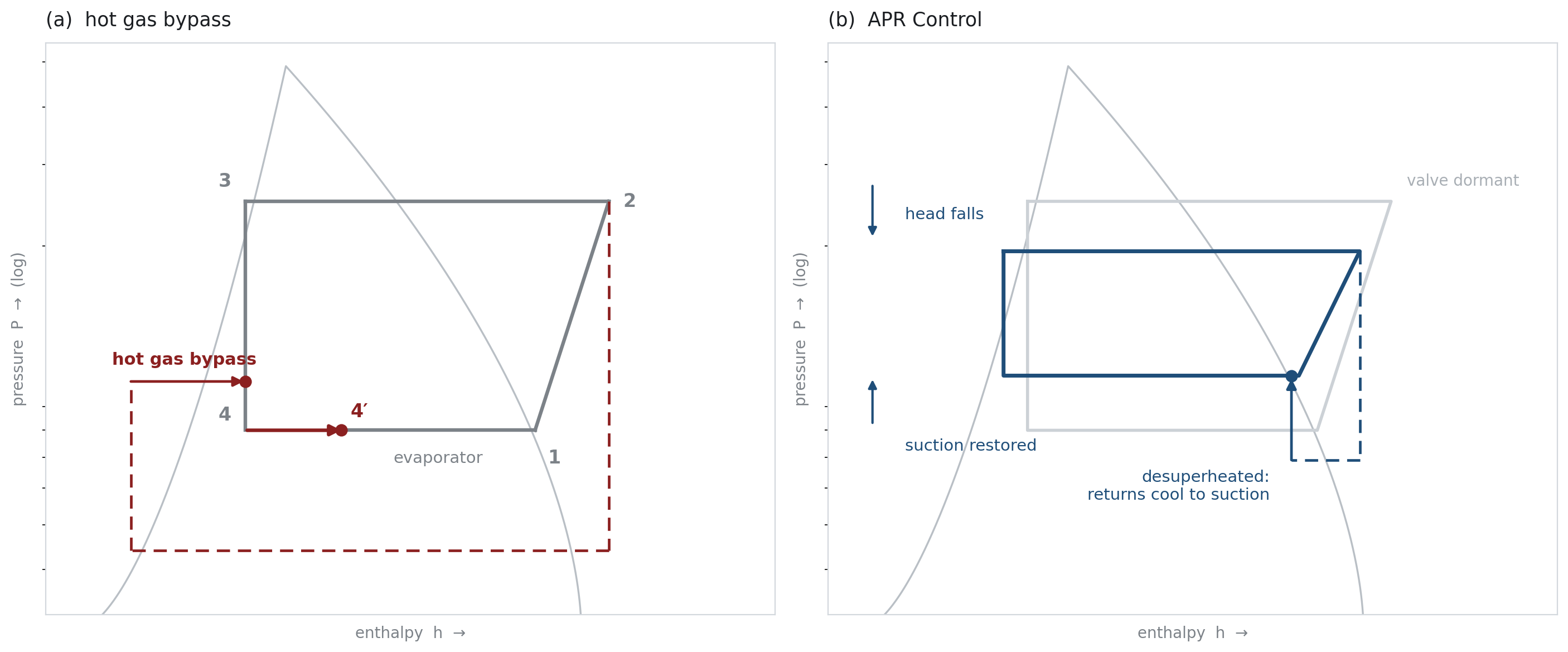
Figure 1 places the two devices on a schematic pressure–enthalpy (P–h) diagram. The figure is illustrative (axes are not to scale and state points are not plotted from measured data), but the features it depicts are anchored to the instrumented record cited in Section 4. In panel (a), conventional hot gas bypass throttles discharge gas to the point after the metering device, before the evaporator: throttling is essentially isenthalpic, so the gas arrives at the evaporator inlet with its enthalpy, and its heat, intact. Mixing shifts the evaporator-inlet state to the right (in refrigerant terms, a rise in vapor quality, so the coil is fed a drier mixture), and the coil spends its surface evaporating recirculated discharge heat instead of carrying building load: the false load in literal form. Suction pressure is propped up by that manufactured duty, but the cycle's lift (condensing over evaporating pressure) is unchanged, and so are compressor mass flow and power: the heat simply recirculates through the coil.
In panel (b), the APR Control's diverted gas takes the same pressure drop but then moves left along the low-pressure line: the desuperheating chamber removes the gas's heat before it rejoins the suction stream, so it returns cool (measured: chamber 67–86°F against 125–200°F discharge). Meanwhile the active cycle itself shrinks vertically: suction pressure is restored toward the setpoint and head pressure falls, so the compressor's lift, its compression ratio, contracts (measured: 2.48 to 1.91 in the matched bench pair), and refrigerant circulation through both heat exchangers is reduced. The leftward enthalpy cut in the diversion path and the vertical contraction of the cycle are the two features hot gas bypass cannot produce, and they are precisely the two features the instrumentation records. Stated in cycle terms [7]: the device’s measured action is the modulation of the cycle’s two adiabatic legs (compression operating at reduced ratio, expansion at reduced differential) while both heat-exchange legs simply receive less flow; hot gas bypass preserves both legs at full severity and adds a false load. The vertical contraction also carries the expansion endpoint further left into the vapor dome, lower quality entering the evaporator; Section 4.6 takes this up.
4. THE MEASURED RECORD AGAINST EACH PROPERTY
4.1 Property 1 fails: the diverted gas returns cool, not hot (measured, laboratory DOAS instrumentation)
The laboratory DOAS unit instruments the diversion circuit directly: pressure and temperature at the APR discharge connection, the APR suction connection, and inside the desuperheating chamber. Across all running periods in the logs, the desuperheating chamber measured 67–86°F while compressor discharge measured 125–200°F. Port-pressure agreement confirms the flow path: APR-discharge pressure tracked condenser-inlet pressure within approximately 0.5 psi, and APR-suction pressure tracked compressor-suction pressure within approximately 1 psi. Hot gas enters; cool gas leaves. A hot-gas-bypass loop has no desuperheating chamber and would show the bypass line at or near discharge temperature. The defining thermal signature of hot gas bypass is absent, and its inverse is present.
The suction-side blend confirms the same point from the other end (measured, same dataset): in one log the evaporator-exit gas showed essentially zero superheat (median 0.1°F) while compressor-inlet gas carried 12–13°F of superheat, with the APR return line at approximately 83°F against a 59°F mixed-suction temperature. The compressor's protective superheat is manufactured by blending modestly warm, not hot, return gas into the suction stream. Under hot gas bypass, suction gas temperature is elevated by design; here the return stream is far below discharge temperature and only modestly above suction.
4.2 Property 2 fails: the compressor unloads (measured, bench dataset)
The bench test provides matched-condition pairs (identical entering air and outdoor conditions with the valve open versus closed) and an untreated second compressor on the same unit as an internal control. In all 24 of 24 matched pairs with the APR Control active, the treated compressor showed lower amperage (−0.2 to −1.0 A), lower compression ratio (reductions up to 23%; e.g., 2.48 to 1.91), and lower dome temperature (−0.7 to −14.1°F). Sump temperature was unchanged or lower in 21 of 24 pairs. The untreated compressor showed no such changes over the same runs. The magnitudes scale with modulation depth and vanish when the valve is dormant. At the deepest modulation observed, the unmodulated compressor draws up to 16% more power. A false-load device cannot produce this signature; a compressor serving a false load keeps working.
4.3 Property 3 fails: proportional capacity modulation, not a fixed energy penalty (measured, bench dataset)
The bench data show proportional modulation: capacity reductions grade continuously with load down to −18.7% of the full two-compressor stage, and to −37.5% of the treated compressor's circuit at the deepest single-stage condition, while suction pressure held the 118–120 psig setpoint band. The laboratory DOAS unit independently held a 113–122 psig suction band across three separate logs (the identification of that band as the setpoint is an inference; the setpoint value is not recorded in that dataset). Equally important is what happens when modulation is not needed: at full-load matched conditions, capacity with the valve present differed from the valve-absent baseline by −2.5% to +0.5%, within the bench's 0.8–1.6% run-to-run repeatability, so no capacity penalty is imposed when full capacity is called for. Hot gas bypass has no proportional-modulation behavior to compare; it is a minimum-load device whose operation is defined by wasted compressor work. The APR Control's active operation is defined by reduced compressor work (Section 4.2).
4.4 Property 4 fails: compressor thermal stress falls (measured, bench dataset)
The known liability of hot gas bypass is elevated discharge temperature and compressor overheating. The APR Control's measured record is the inverse: dome temperature lower in every one of the 24 matched pairs, discharge pressure lower, compression ratio lower, with effects scaling with modulation depth. Under modulation, compressor superheat on the bench ran 12–20.5°F, meaning the desuperheating chamber alone carried the duty and the liquid injection valve remained essentially unexercised. The device does not need protecting from its own bypass heat; it removes the heat before the gas returns.
4.5 Circulation through both heat exchangers is reduced (measured, bench dataset)
A conventional hot-gas-bypass-to-evaporator arrangement deliberately pushes the false load through the evaporator; coil flow is preserved or nearly so. The APR Control's diversion loop instead circumvents both heat exchangers. Direct measured evidence: with the valve active, the evaporator's saturated suction temperature rose (24.2°F closed versus 32.3°F open in the matched pair at identical conditions) and the condenser approach temperature halved (14.8°F to 7.0°F), with both coils operating at reduced approach, consistent with reduced refrigerant mass flow per unit of coil surface. A supporting mass-balance analysis in the companion mechanism paper found compressor-side and air-side capacity computations diverging 20–28% when the valve is active versus 1–8% agreement at baseline; the computed flow channels underlying that analysis are compressor-map mass-flow values.
4.6 Refrigerant quality in the evaporator: the two devices push it in opposite directions
The contrast of the preceding sections can be restated in terms of the vapor quality of the refrigerant in the evaporator, and the restatement is the most physical form of the distinction. Hot gas bypass raises the quality of what the coil receives. By definition (Section 2), discharge vapor is injected downstream of the expansion device: the two-phase mixture leaving the metering device is blended with superheated gas, so the stream entering the coil carries a higher vapor fraction and the injected heat besides. A drier mixture holds less liquid per pound of flow, reaches dryout earlier along the circuit, and leaves a longer portion of the coil working in the dry-vapor region, where refrigerant-side heat transfer is poorest. Load-based capacity reduction under hot gas bypass is therefore achieved by degrading the evaporator: the coil is made less efficient (less useful heat transfer per unit of surface and per unit of refrigerant flow) while the compressor stays fully loaded. This paragraph is definitional; no hot-gas-bypass system was tested in this program.
The APR Control alters nothing that enters the evaporator. The diverted gas never reaches the coil (Section 4.1); the expansion device feeds the evaporator exactly as it does in an unmodified circuit. What keeps the coil wetter at part load is the load itself, or rather the lack of it. With less heat arriving at the coil, the refrigerant the expansion device delivers boils away more slowly, and liquid persists further along the circuit. The same scarcity of load, expressed through the modulated cycle's reduced lift (condenser approach halved, 14.8°F to 7.0°F; compression ratio 2.48 to 1.91, both measured), also means the liquid reaching the metering device flashes less across it, so what enters the coil starts at lower vapor quality. The valve's role is to make that state sustainable: by unloading the compressor and holding suction pressure at setpoint, it lets the system run steadily at the light load rather than tripping or short cycling. The pressure reductions are measured; the quality effects are derived from them thermodynamically; no dataset in this program instruments vapor quality directly. At the exit end, the laboratory DOAS record supplies a measured anchor: evaporator-exit superheat held at a median of 0.1°F while the compressor's protective superheat was manufactured at the suction blend (Section 4.1), which is a coil wetted essentially end to end.
The result is the mirror image of hot gas bypass at the same part load. Hot gas bypass reaches into the evaporator's feed and dries the coil; the APR Control leaves the feed alone, and the coil runs wetter because the load is light: reduced refrigerant flow means more surface area per unit of flow, more residence time, and more of that surface wetted and boiling. Capacity is reduced by making the evaporator more efficient (more heat transfer per unit of surface and per unit of refrigerant flow) with the compressor unloaded in proportion (Section 4.2), rather than by making it less efficient with the compressor fully loaded. The reduced-approach observations of Section 4.5 are consistent with this picture, with the caveat disclosed in the companion mechanism paper [5] that reduced duty and improved coil effectiveness move together in that record and are not fully separable. Efficiency here means thermal-transfer efficiency per unit of surface and flow, not unit-level EER, whose part-load power-versus-capacity trade is disclosed in the companion bench papers [5], and not per-hour moisture-removal rate, which the companion series treats separately.
5. SUMMARY TABLE
| Property claimed by the label | Hot gas bypass (definition) | APR Control (instrumented record) | Evidence class |
|---|---|---|---|
| Temperature of gas delivered to low side | At or near discharge temperature; heat is the false load | Desuperheating chamber 67–86°F vs. discharge 125–200°F; cool gas returned to suction | Measured (DOAS lab) |
| Compressor loading and power | Compressor stays loaded; power does not fall | Amps, compression ratio, dome temperature lower in 24/24 matched pairs; the same compressor without the valve draws up to 16% more power at deepest modulation; the untreated second compressor unchanged | Measured (bench) |
| Energy character | Deliberate energy penalty; work with no cooling produced | Proportional capacity modulation holding 118–120 psig setpoint; no capacity penalty at full load (within bench repeatability) | Measured (bench) |
| Compressor thermal stress | Raised; overheating is the classic failure mode | Dome temperature −0.7 to −14.1°F in every matched pair; discharge pressure lower | Measured (bench) |
| Coil refrigerant circulation | Preserved; false load pushed through evaporator | Both coils at reduced approach (evap sat suction 24.2→32.3°F; condenser approach 14.8→7.0°F); diversion loop circumvents both coils | Measured (bench); mass-balance analysis in companion paper |
| Refrigerant quality in the evaporator | Raised: discharge vapor blended in downstream of the metering device; drier coil | Feed untouched: expansion device meters normally; lack of coil load and reduced flash keep the coil wetter; exit superheat ~0°F in the DOAS log | Definitional (HGB); derived from measured pressures; exit superheat measured (DOAS lab) |
6. WHERE THE DEVICE ACTUALLY SITS IN THE LITERATURE
The mechanism family the APR Control belongs to functionally is suction gas modulation. Wang, Han, Shi, and Li [1] modeled and tested suction-gas-bypass modulation of a scroll compressor and found that it reduces inner compression loss and improves COP at part load: compressor-level efficiency gains under modulation, the same direction as the compressor-level record in Section 4.2. That is the correct academic anchor for the APR Control. The hot-gas-bypass literature (false loading, minimum-load stability, discharge-temperature management) is the wrong shelf, and citing the device into it propagates the wrong physics.
7. THE CODE CONSEQUENCE OF THE MISLABEL
The mislabel is not merely a technical inaccuracy; it has plan-review consequences. ASHRAE 90.1 addresses hot gas bypass in a dedicated prescriptive section, §6.5.9 “Hot Gas Bypass Limitation” [3]. The IECC commercial provisions carry the parallel requirement [4]: cooling systems shall not use hot gas bypass or other evaporator pressure control systems unless the system is designed with multiple steps of unloading or continuous capacity modulation, and hot-gas-bypass capacity is capped at 50% of total capacity for units rated at or below 240,000 Btu/h and 25% above that. These limitations exist because hot gas bypass, correctly defined, wastes compressor energy at part load, exactly Property 3 of Section 2.
A device labeled “hot gas bypass” on a submittal gets swept into those restrictions in plan review even when its measured behavior is the opposite of what the restriction targets. The APR Control's measured behavior at part load is reduced compressor power (Section 4.2), and its operation is continuous capacity modulation, the very system character the code language names as the acceptable alternative. The label therefore does double damage: it invites a restriction written for a different device, and it obscures that the APR Control's operating character is on the compliant side of the code's own distinction. (Application of any code section to a specific project is a determination for the engineer of record and the authority having jurisdiction; the point here is that the determination should be made against the device's actual mechanism, not a borrowed label.)
8. THE BROADER COST: IMPORTED OBJECTIONS AND CORRUPTED REFERENCE MATERIAL
An engineer or specifier who hears “hot gas bypass” reasonably assumes an energy penalty, no power reduction at part load, elevated discharge temperature, and compressor-overheating risk. Every one of those assumptions is contradicted by the measured record in Section 4, and the burden of un-teaching them falls on every submittal review, specification response, and sales conversation. (This pattern is reported from application and field experience.)
The mislabel also propagates into reference material and automated systems. Machine-learning systems trained on general HVAC literature pattern-match “discharge gas diverted to suction” onto the hot-gas-bypass template and then reproduce all four false properties as if they were facts about the APR Control. Every document that applies the label feeds the error. The remedy is to describe the mechanism rather than borrow a label for it.
9. CORRECT TERMINOLOGY
The following usage accurately describes the device and is used across the companion white paper series:
Product-level descriptor: “modulating external compressor unloader” or “external compressor unloading device.”
Mechanism description: “diverts a controlled portion of compressor discharge through a desuperheating chamber, returning cool gas to suction.”
Mechanism family: “suction gas modulation” (per [1]); “diversion” or “diverting” language for the flow path.
Prohibited as a descriptor: “hot gas bypass,” “discharge bypass,” and “discharge-gas bypass.” The term “hot gas bypass” should appear only in an explicit, direct contrast against actual hot-gas-bypass modulation, as it does throughout this paper.
10. CONCLUSIONS
“Hot gas bypass” is a definition, not a description of pipe routing, and the definition makes four testable claims: hot gas delivered to the low side, a compressor that stays loaded, a deliberate energy penalty, and elevated compressor thermal stress. Instrumented data from a controlled bench test and an independently instrumented laboratory DOAS unit show the APR Control exhibits the opposite of all four: the diverted gas returns cool (67–86°F chamber against 125–200°F discharge); the compressor unloads rather than staying loaded (lower amperage in every matched pair, the unmodulated compressor drawing up to 16% more power); the action is proportional capacity modulation to a suction-pressure setpoint with no full-load capacity penalty, not a fixed energy penalty; and compressor thermal stress falls rather than rises (compression ratio 2.48 to 1.91 at the deepest pair, dome temperature lower in 24 of 24 matched pairs). A fifth measured result sits alongside the four: the diversion loop circumvents both heat exchangers, so both operate at reduced approach. Restated at the refrigerant: hot gas bypass reduces capacity by injecting vapor into the evaporator's feed and degrading the coil; under the APR Control the feed is untouched, the light load keeps the coil wetter, and the result is a more effective coil and an unloaded compressor. The device is a modulating external compressor unloader in the suction-gas-modulation family. Calling it hot gas bypass attributes to it the physics, the liabilities, and the code restrictions of a device it is not.
REFERENCES
[1] Wang, B., Han, L., Shi, W., and Li, X., 2012. “Modulation method of scroll compressor based on suction gas bypass.” Applied Thermal Engineering, Vol. 37, pp. 183–189. doi:10.1016/j.applthermaleng.2011.11.014. Available: https://doi.org/10.1016/j.applthermaleng.2011.11.014
[2] Rawal Devices, Inc., 2020. “APR Control vs. Hot Gas Bypass.” Two-page technical comparison. Available at rawal.com. Available: https://www.rawal.com/wp-content/uploads/2021/01/RAWAL_APR_is_NOT_HGBP_WhitePaper_2PG_1.21.20.pdf
[3] ANSI/ASHRAE/IES Standard 90.1, Energy Standard for Buildings Except Low-Rise Residential Buildings, Section 6.5.9, “Hot Gas Bypass Limitation.” Available: https://www.ashrae.org/technical-resources/bookstore/standard-90-1
[4] International Energy Conservation Code (IECC), Commercial Provisions, Section C403 (“Hot Gas Bypass Limitation”; designation varies by edition, e.g., C403.4.6 in 2018): cooling systems shall not use hot gas bypass or other evaporator pressure control systems unless the system is designed with multiple steps of unloading or continuous capacity modulation; maximum hot gas bypass capacity 50% of total capacity for rated capacity ≤240,000 Btu/h and 25% above 240,000 Btu/h. Available: https://codes.iccsafe.org/content/IECC2021P2/iecc-commercial-provisions
[5] Santos, J. “Bench-Test Evidence for the APR Control” (companion white paper series, Papers 1–6: capacity, power, refrigerant-side mechanism, compressor operating stress, freeze-exposure census).
[6] Santos, J. “Instrumented Verification of the APR Control Diversion Circuit on an R-454B Dedicated Outdoor Air System” (companion white paper).
[7] Demma, D., 2005. “The Pressure-Enthalpy Chart.” Sporlan (Parker Hannifin Corporation), Form 5-200, January 2005. Available: https://www.parker.com/content/dam/Parker-com/Literature/Sporlan/Sporlan-pdf-files/Sporlan-pdf-Miscellanous/5-200.pdf