
Humidity Control
Humidity Control
Oversized equipment cools fast and shuts off before it removes much moisture. APR Control keeps the system running at part load, so the coil stays cold and keeps pulling humidity from the space.
Cooling fast doesn't dry the air
Dehumidification takes time. Moisture is removed only while the coil is cold and air is moving across it. An oversized system drives the space to setpoint quickly and shuts off, so the coil spends little time actually pulling water out of the air. The thermostat is satisfied, but the space feels clammy and relative humidity drifts up.
How APR Control reduces humidity
APR Control keeps the system running at reduced capacity instead of cycling off. The compressor runs far longer between starts, so the coil stays cold and keeps pulling moisture from the air through the long part-load hours instead of shutting off after a few minutes.

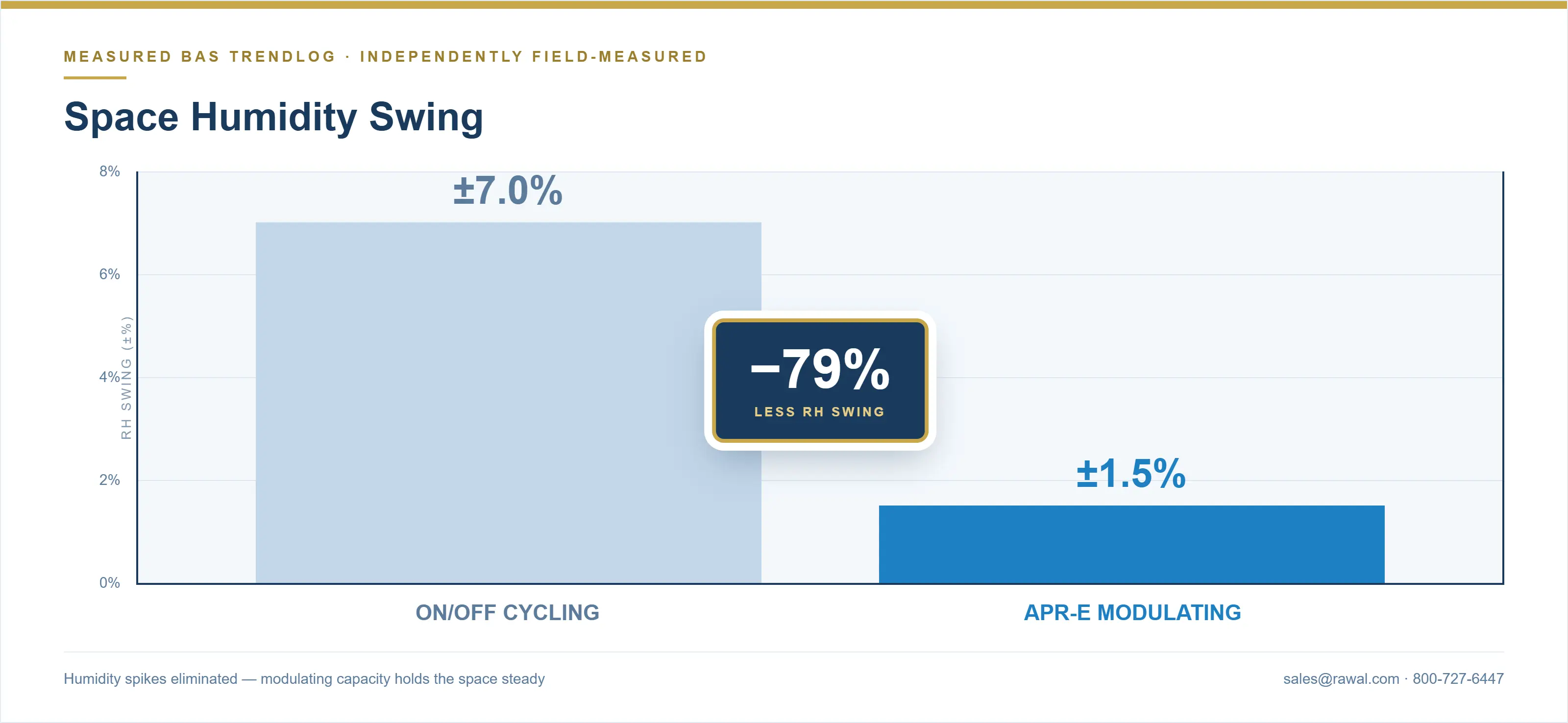
Longer, steadier run time keeps the coil doing the work of dehumidification. In an independent field study, roughly 53% relative humidity was held through a full summer of operation (Independent Field Study).
When you need a precise leaving-air condition
Where an application needs a precise, repeatable leaving-air condition, the electronic APR‑E Valve holds discharge air temperature to ±1°F on DAT control. In some dehumidification applications, running longer at reduced capacity can reduce or eliminate the need for hot gas reheat: see APR Control vs. hot gas reheat.

At a separate office project in Reading, PA, the result was tighter still:
“Humidity levels within the space were held at 45% to 50% all summer long within an office environment. The customer was very pleased and expressed that the temperature setpoint was raised in most of the office zones as a result of the people within the space feeling more comfortable.”
Bob Reichenbach · Service Manager, The Warko Group, Reading, PA
Solve your humidity problem
for good.
Tell us the space and the equipment, and we size the APR Control to hold the humidity, on us, with a one-business-day response.
Get Expert Help[email protected] · 800‑727‑6447 · rawal.com